The Prompt Is Still a Punch Card
July 2, 2026
The intelligence felt radically new. The interface felt strangely old.
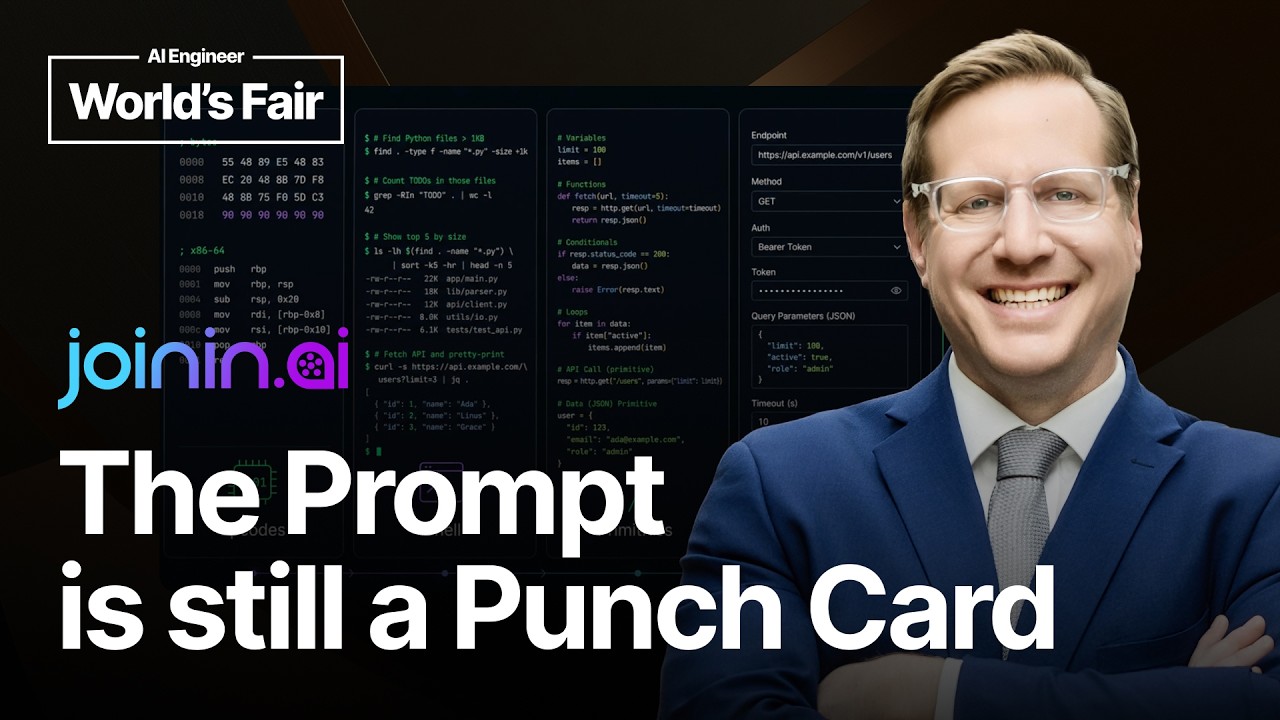
I recently gave a talk at AI Engineer World's Fair called "The Prompt Is Still a Punch Card" about a simple idea that has been bothering me since the first time I used modern AI:
The intelligence felt radically new.
The interface felt strangely old.
The keyboard, command line, mouse, menus, forms, voice assistants, and even prompts were all brilliant compromises with the machines of their time. They helped us get work done. They made computers usable. But they also taught humans to reshape our intent around what machines could understand.
Watch the Talk
Brilliant Compromises
At the conference, I heard similar themes about the new possibilities AI is unlocking and how interfaces have changed over time. One example from the voice space was Kwindla Hultman Kramer, CEO of Daily and creator of Pipecat, sharing a related view on the future expectations of interfaces: Pipecat Cloud: Enterprise Voice Agents Built On Open Source.
That is the main argument of my talk: AI should not just make software smarter. AI should change the interface between humans and computers.
Learning Where to Punch the Holes
For decades, the pattern has been mostly the same. Humans learn the machine's protocol. We encode intent into commands, fields, clicks, forms, and now prompts. Prompt engineering is useful, but it is also a sign of the mismatch. We are learning how much context to provide, how to phrase constraints, how to ask for format, how to repair the answer, and how to keep the model from drifting.
In other words, we are all learning where to punch the holes.
Renegotiating the Bargain
But AI gives us a chance to renegotiate that bargain.
If computers can now reason, listen, speak, infer, summarize, clarify, and adapt, then the interface should become more human-compatible. Not just more conversational in the shallow sense of "speech in, speech out," but conversational in the deeper sense: timing, attention, interruption, ambiguity, repair, shared context, and knowing when to stay silent.
Voice Is the Stress Test
That is why voice is such an interesting stress test. A voice interface can sound natural and still be conversationally lost. The real question is not whether AI can talk. The question is whether it understands what kind of moment it is in.
Is this a moment to answer?
A moment to ask a clarifying question?
A moment to show something visually?
A moment to send a quiet note?
Or a moment to do nothing?
The next frontier is not just better models or better voices. It is better interaction.
The Next Frontier Is Interaction
The point is not that prompts are bad. Punch cards were powerful too. The point is that prompts may be another transitional interface: a way for humans to package messy intent into a format the machine can accept.
AI should help computers meet humans in the rich, messy protocols we already use with each other. That is the mindset shift I hope people take from the talk.
The question is not only whether AI gets smarter.
The question is which old constraints we stop accepting as fundamental — and what new interfaces that freedom might inspire.