
Baton Is #2 of 13 on LiveKit's End-of-Turn Benchmark
October 6, 2026
A third party ran our turn-taking engine on their own harness and published the result. Here is what it measures, and why the question matters more in a room of four.
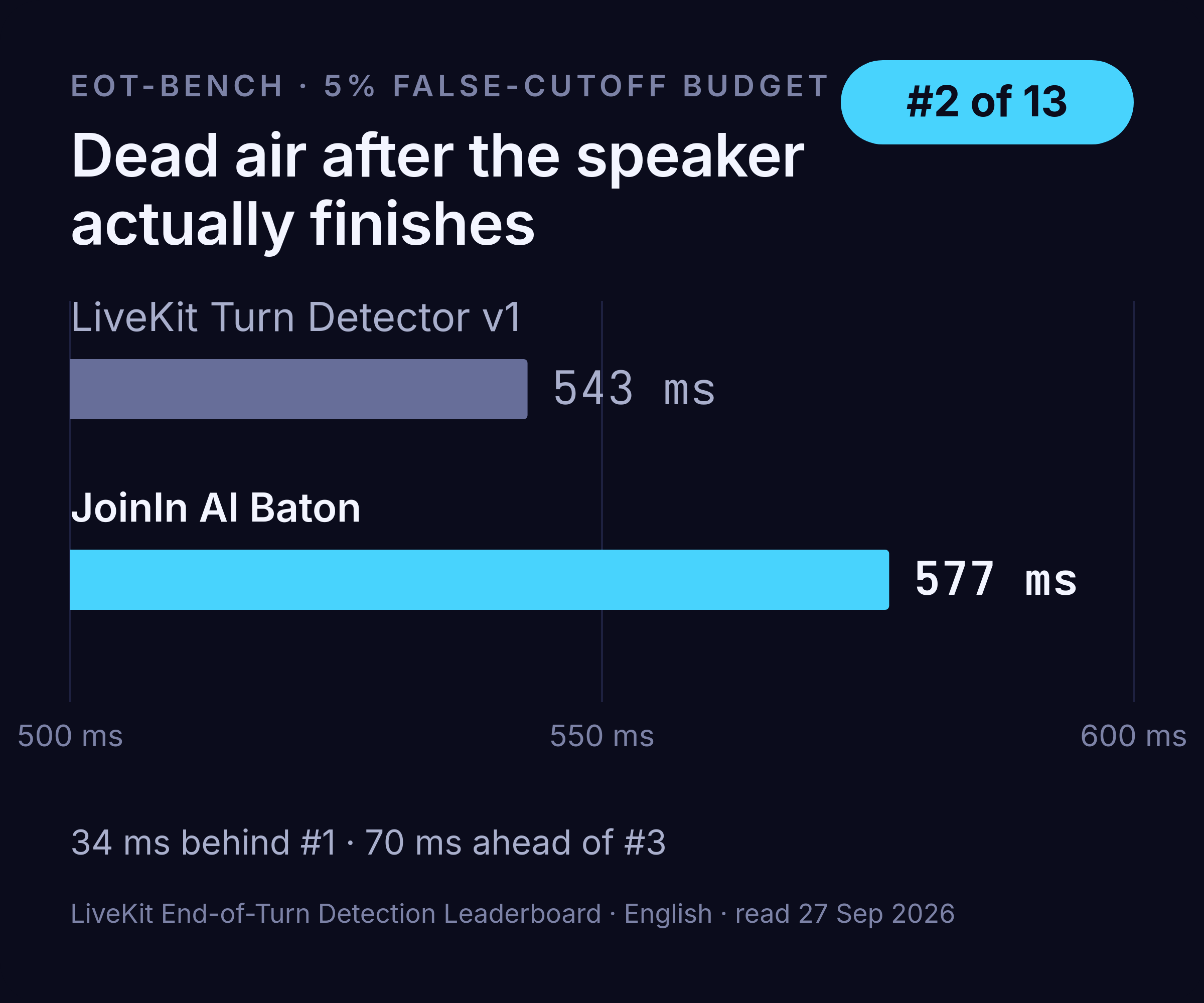
Every voice AI has to answer one question before it can say anything: has this person actually finished? LiveKit's eot-bench is a public, third-party measurement of exactly that, scored causally at real pauses across two-party calls. We did not build it and we cannot tune it. Last week LiveKit ran our submission through their harness and published it as “JoinIn AI Baton”.
The benchmark: eot-bench, LiveKit’s public end-of-turn leaderboard. More on Baton on the Baton page; the API is documented at docs.joinin.ai.
The result
The board lets you hold every model to the same budget on one axis and rank on the other. Baton is second of thirteen entries on both:
- At a 300 ms latency budget, Baton cuts speakers off 12.3% of the time. The leader, LiveKit's own Turn Detector v1, is at 9.9%; Deepgram Flux is third at 12.9%.
- At a 5% false-cut-off budget, Baton hands the turn over after 577 ms of silence. The leader is at 543 ms; Soniox is third at 647 ms. The realtime APIs and the VAD baseline sit between 900 ms and 1.6 s.
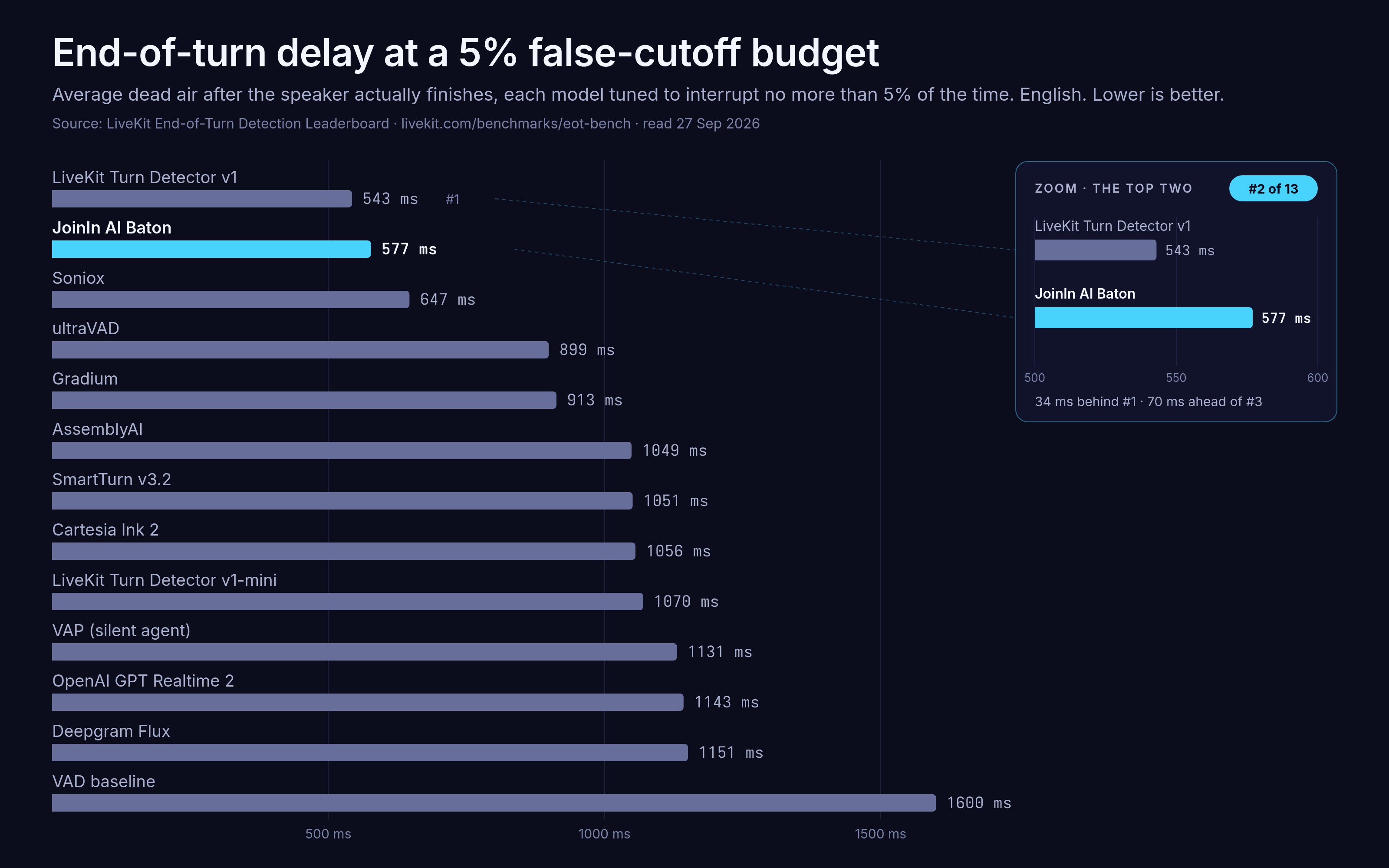
One thing the chart does not show: the only entry ahead of Baton is tied to LiveKit's platform. LiveKit Turn Detector v1 runs only on LiveKit's own servers, and you get it when your agent is hosted on LiveKit Cloud. Host your agent anywhere else and you get v1-mini, the smaller model that runs on your own CPU — ninth on this chart at 1070 ms. Baton is one hosted API that gives the same result whatever stack or cloud your agent runs on.
The board's other axis holds latency to 300 ms and ranks by how often each model cuts a speaker off. Baton is second there too, and beats Deepgram Flux on every column:
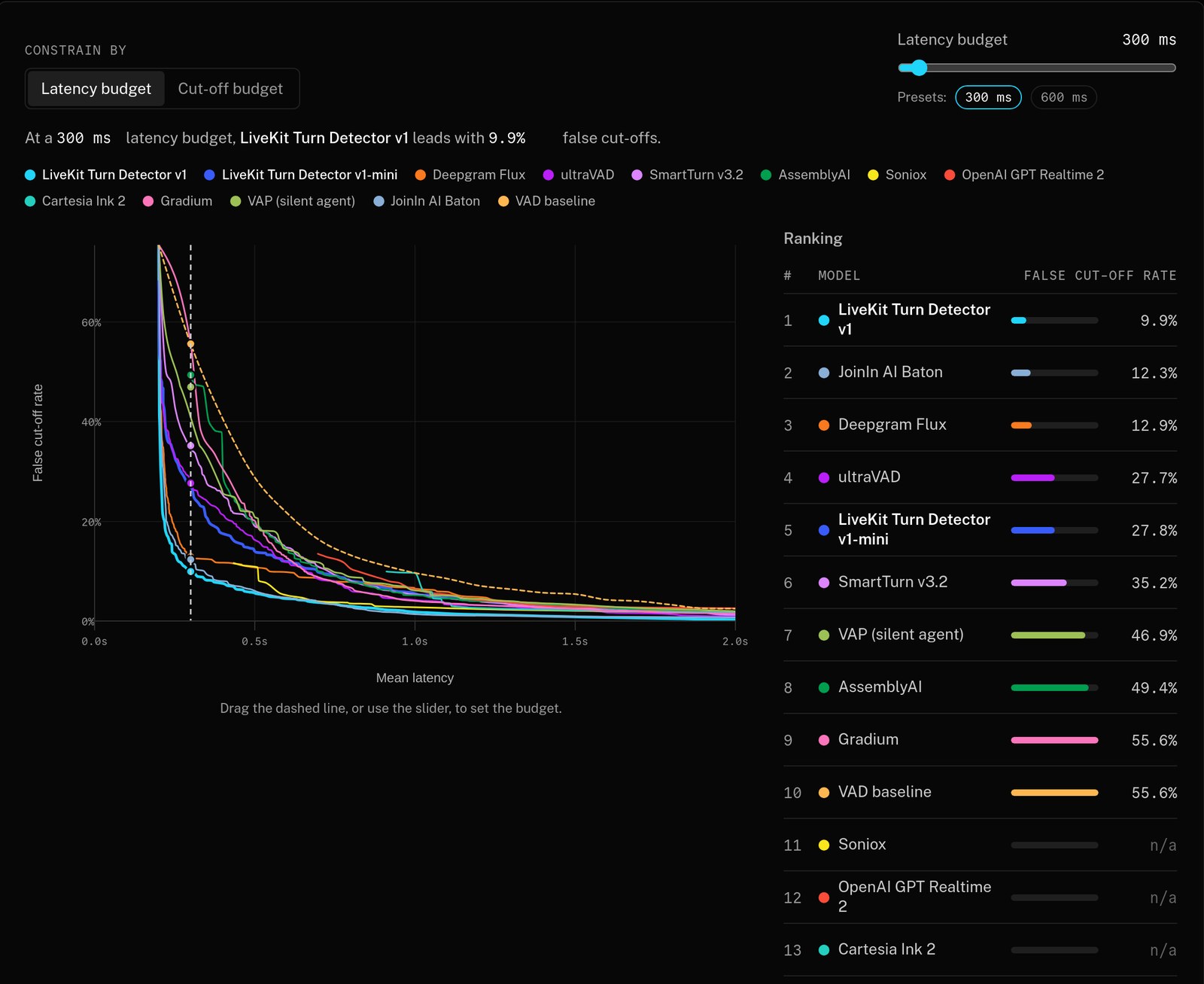
Data and charts from LiveKit's leaderboard, read September 27, 2026. Click either to open the live board.
| Model | False cuts @300 ms | @600 ms | Latency @5% |
|---|---|---|---|
| LiveKit Turn Detector v1 | 9.9% | 4.5% | 543 ms |
| JoinIn AI Baton | 12.3% | 4.8% | 577 ms |
| Deepgram Flux | 12.9% | 9.9% | 1151 ms |
| ultraVAD | 27.7% | 11.9% | 899 ms |
| LiveKit v1-mini | 27.8% | 12.1% | 1070 ms |
| Smart Turn v3.2 | 35.2% | 14.8% | 1051 ms |
| Soniox | n/a | 5.5% | 647 ms |
| OpenAI GPT Realtime 2 | n/a | n/a | 1143 ms |
| VAD baseline | 55.6% | 21.7% | 1600 ms |
English rows as LiveKit publishes them in livekit/eot-bench: false cut-offs at 300 ms and 600 ms latency budgets, mean latency at a 5% cut-off budget. “n/a” means no operating point reached that budget. Baton's latency at the 10% budget is 350 ms. The prediction artifacts behind every row are committed in the harness, so any of this can be re-scored.
We predicted the number before LiveKit measured it: our own pre-submission mean was 12.5%, and their run came in at 12.3%.
Two more boards, run by us on public test sets, point the same way:
| Benchmark | Baton | Best other |
|---|---|---|
| SID-Bench · false interruptions | 5.2% | 14.0% · the paper’s SID model |
| Speko turn-taking · false cut-offs | 1.2% | 2.6% · Smart Turn v3.2, same clips |
| Speko turn-taking · accuracy | 93.2% | 94.0% · Smart Turn v3.2, board (200 clips) |
Self-run with each benchmark’s published method: our estimates, not entries on those boards.
LiveKit's board ranks English. We measure every language in the evaluation set the same way, and the API serves these operating points directly:
Baton in 14 languageslatency at 2%, 5% and 10% false cut-offs
| Language | At 2% false cut-offs | At 5% | At 10% |
|---|---|---|---|
| English | 861 ms | 563 ms | 317 ms |
| Arabic | 1099 ms | 811 ms | 622 ms |
| Chinese | 1105 ms | 841 ms | 605 ms |
| Dutch | 1085 ms | 784 ms | 582 ms |
| French | 978 ms | 700 ms | 418 ms |
| German | 1210 ms | 799 ms | 489 ms |
| Hindi | 798 ms | 629 ms | 514 ms |
| Indonesian | 1378 ms | 881 ms | 661 ms |
| Italian | 2000 ms | 941 ms | 654 ms |
| Japanese | 670 ms | 496 ms | 350 ms |
| Korean | 844 ms | 628 ms | 421 ms |
| Portuguese | 1025 ms | 784 ms | 616 ms |
| Spanish | 1154 ms | 848 ms | 645 ms |
| Turkish | 1238 ms | 980 ms | 712 ms |
Self-measured, October 2026: mean delay from the end of speech to Baton’s turn end, holding false cut-offs to each budget, on the languages in eot-bench’s evaluation set. These are the operating points the API serves; pick one per session (docs). LiveKit’s own run of the English set measured 577 ms at 5%.
Why end-of-turn matters
Why it matters, in one minute:
Reply too early and you cut the speaker off mid-sentence. Reply too late and the moment has passed; the room has moved on without you. The benchmark scores both failures at once, which is why a single headline number is never the whole story: the question is how little waiting a model needs before it stops interrupting people.
Why it matters more in a meeting
In a one-on-one, a pause is an invitation. There is nobody else it could be for. In a meeting, most pauses belong to someone else: the person who was asked the question, the person who always jumps in, the person still thinking. An AI that treats every pause as its turn talks over the room, and a room learns to ignore it within minutes.
So Baton asks two questions before every word. Has the speaker finished, which is what eot-bench measures. And is the floor actually open, which no public benchmark measures yet. The second question rests entirely on the first: get end-of-turn wrong and nothing built on top of it can be right.
Baton does much more
End-of-turn is where Baton starts. It also tells real interruptions from “mm-hm”s, separates and transcribes up to eight voices from one mixed feed, follows each speaker's language, and decides whose turn it is in a group. That last part is what our polyadic benchmark measures, with four- to six-person meetings and deterministic scoring, and we will publish it the same way: a harness anyone can run.
Baton runs inside Pulse, our meeting participant, which you can try on a real call today. As a standalone service, we are now providing access to early enterprise customers. The endpoints, the signals, and the measured operating points are on the Baton page; the API reference is in the Baton documentation. To talk about access, write to hello@joinin.ai.